
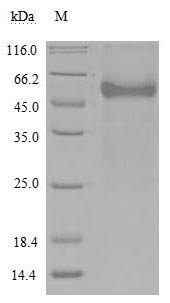
Recombinant Human Tumor necrosis factor receptor superfamily member 14 (TNFRSF14), partial (Active)
Recombinant Human Tumor necrosis factor receptor superfamily member 14 (TNFRSF14), partial (Active)
Product Details
| Purity | ≥ 90% as determined by SDS-PAGE. |
|---|---|
| Endotoxin | Less than 1.0 EU/ug as determined by LAL method. |
| Target Names | TNFRSF14 |
| UniProt No. | Q92956 |
| Alternative Names | HVEML; ATAR; CD270; CD40 like protein precursor; Herpes virus entry mediator A; Herpesvirus entry mediator A; Herpesvirus entry mediator; Herpesvirus entry mediator ligand; HveA; HVEM; HVEM L; LIGHT; LIGHTR; TNFRSF14; TNFSF 14; TNR14_HUMAN; TR2; Tumor necrosis factor receptor like gene2; Tumor necrosis factor receptor superfamily member 14; Tumor necrosis factor receptor superfamily member 14 precursor; Tumor necrosis factor receptor-like 2 |
| Source / Host | Mammalian cell |
| Tag | C-terminal hFc1-tagged |
| Protein Length | Partial |
| Molecular Weight | 48.5 kDa |
| Formulation | Lyophilized from a 0.2 μm sterile filtered PBS, 6% Trehalose, pH 7.4 |
| Reconstitution | We recommend briefly centrifuging the vial prior to opening to bring the contents to the bottom. Reconstitute the lyophilized protein in sterile deionized water to a recommended concentration of 0.1–1.0 mg/mL. If used immediately after reconstitution, glycerol is not required. If not for immediate use, after the protein is completely dissolved, add glycerol to a final concentration of 5%–50% (default: 50%), aliquot as needed, and store at -20℃/-80℃ for long-term storage. If dilution is needed during subsequent use, dilute with the same buffer as the protein, but without stabilizers (e.g., glycerol, trehalose, etc). Troubleshooting and FAQs Protein FAQs |
| Storage | Store at -20°C/-80°C upon receipt, aliquoting is necessary for mutiple use. Avoid repeated freeze-thaw cycles. |
| Lead Time | 3-7 business days |
Description
TNFRSF14 (HVEM/CD270) functions as a critical immune checkpoint receptor at the crossroads of co-stimulatory and co-inhibitory signaling in tumor microenvironments, making it a high-value target for immuno-oncology drug discovery. This recombinant construct spans the extracellular ligand-binding domain (aa 39–202) with a C-terminal hFc1 tag, produced in mammalian cells to preserve native glycosylation and disulfide-dependent folding essential for accurate ligand recognition. Functional ELISA confirms robust binding to human TNFSF14 (LIGHT) with an EC50 of 49.85–79.31 ng/ml, supporting direct… Read more